In case you missed it:
Bias? Who's biased?
The Media: After listening to the president's news conference on Tuesday, we really found nothing to argue with. Which puts us at odds with the rest of the press corps, which seems to argue with everything Bush says.
We've got to hand it to the president. There must be more pleasant and productive ways to spend a spring morning than by fielding two dozen loaded questions designed to put you, your team and your policies in as bad a light as possible.
Herewith a sampling from Tuesday's Q&A, along with excerpts from some of the answers we thought most noteworthy:
Q: Iraq's former prime minister, Iyad Allawi, said Sunday that violence is killing an average of 50 to 60 people a day - and that if this is not civil war, then God knows what is. Do you agree with Mr. Allawi that Iraq has fallen into civil war?
A: I do not. The way I look at the situation is that the Iraqis took a look and decided not to go to civil war. The army didn't bust up into sectarian divisions, (and) I was pleased to see the religious leaders stand up . in denunciation of violence and the need for the country to remain united. The political leaders, who represent different factions of Iraqi society, have committed themselves to moving forward on a unity government.
Q: You describe Iran as a threat. Yet you're close to opening talks with them about Iraq. What would be the objective in these talks if they are not negotiations? And is there a risk of getting drawn into the nuclear issue?
A: I gave our ambassador to Iraq permission to explain to the Iranians that attempts to spread sectarian violence, or to move parts that could be used on IEDs (improvised explosive devices), is unacceptable to the United States. Iraq is a sovereign government. They have a foreign policy. And when they get their unity government stepped up, they will be in charge of negotiating with the Iranians. Our negotiations with Iran on nuclear weapons will be led by the EU-3 (Britain, France and Germany) . as well as Russia and China. The Iranians must hear a unified voice that says they shall not have a capacity to make a nuclear weapon or knowledge as to how to make a nuclear weapon. If the Iranians were to have a nuclear weapon, they could blackmail the world, (and weapons) could proliferate. This is a country that has walked away from international accords.
Q: Your decision to invade Iraq has caused the deaths of thousands of Americans and Iraqis. Every reason (you've) given, publicly at least, has turned out not to be true. Why did you really want to go to war with Iraq?
A: I think your premise is just flat wrong. No president wants war. My attitude about the defense of this country changed on September the 11th, when we got attacked. I vowed then and there to use every asset at my disposal to protect the American people. I saw a threat in Iraq. I was hoping to solve the problem diplomatically. That's why I went to the (U.N.) Security Council. The world said: Disarm, disclose (weapons of mass destruction) or face serious consequences. When (Saddam Hussein) chose not to disclose, then I had the difficult decision to make to remove him. And we did. And the world is safer for it.
Q: If a civil war should break out in Iraq . are you willing to sacrifice American lives to keep Iraqis from killing one another?
A: Our position is, one, to get a unity government formed, and two, to prepare the Iraqi troops, and support Iraqi troops if need be, to prevent sectarian violence from breaking out.
Q: Do you believe you need to make any adjustments in how you run the White House? Many of your senior staffers have been with you from the beginning. Some say they are tired and even tone-deaf.
A. These are good, hard-working people. They've had a lot on their plate. I appreciate their performance . and they've got my confidence. We've been a remarkably stable administration, and I think that's good for the country. Obviously, there are times when government bureaucracies haven't responded the way we wanted them to. And I don't like that at all. It sends wrong signals to taxpayers.
Q: Are you listening to suggestions to bring somebody else into the White House, a wise man, a gray beard, some old-time Washington hand who could steady Congress, (which) is very upset about things?
A: I've listened to all suggestions. We bring Congress down here all the time. I understand there's a certain unease as you head into an election year. And my message to them is: Please continue to give me advice and suggestions. And I take their advice very seriously.
Q. Polls . all say the exact same thing: that a growing number of Americans are questioning the trustworthiness of you and this White House. Does that concern you?
A: I believe that my job is to go out and explain to the people what's on my mind. That's why I'm having this press conference. And what's on my mind is winning the war on terror.
Q: There have been growing calls from some (in Congress) for the resignation of Defense Secretary Donald Rumsfeld, and also from his own former subordinates . who describe him . as incompetent and tactically inept. Do you believe Rumsfeld ought to resign?
A: I think he's done a fine job not only of conducting two battles, in Afghanistan and Iraq, but also of transforming our military, which has been very difficult inside the Pentagon.
Q: Just after the 2004 election, you claimed a really enviable balance of political capital and a strong mandate. Would you make that claim today - that you still have that?
A: I'd say I'm spending that capital on the war.
Q: Is that costing you elsewhere, then, (as with) Social Security?
A: I don't think so. We've worked to get a lot of positive things done. Over the last 12 months, we've got two Supreme Court judges confirmed, we've got the Patriot Act reauthorized over the objections of the Democrat leadership in the Senate. We've got some tort reform passed. We've passed a budget that cut nonsecurity discretionary spending. We've got an energy bill passed. Social Security is a really difficult issue for some members of Congress to deal with, because it is fraught with all kinds of political peril. As a matter of fact, it's been difficult for a lot of Congresses to deal with. So I'm disappointed Congress didn't want to go forward with it, but I'm not surprised. Last year, the tactic was to believe that once the people saw there was a problem, they would then demand a solution. And we made progress on describing the problem. The new tactic is to try to take the politics out of it. There are quiet consultations going on to get a commission that would have a bipartisan appeal to it. This issue is one that's going to require a bipartisan approach. But I'm committed to moving the issue. I think it's important, and I'm not deterred by the fact that nothing happened. As a matter of fact, I take great pride in the fact that I was willing to bring up the issue while others might not have. That's the job of the president.
Q: There (are) now three sponsors to a measure to censure you for the implementation of the terrorist surveillance program. The primary sponsor has suggested that impeachment is not out of the question. What do you think the impact of a discussion of impeachment and censure does to you and this office and to the nation during a time of war and in the context of the election?
A: I did notice that nobody from the Democratic Party has actually stood up and called for getting rid of the terrorist surveillance program. If that's what they believe . then they ought to stand up and say . the tools we're using to protect the American people shouldn't be used. They ought to take their message to the people and say, "Vote for me. I promise we're not going to have a terrorist surveillance program." That's a debate the country ought to have.
Q: The national debt, which was $5.7 trillion when you took office, is now nearly $8.2 trillion. And Congress has just voted to raise it to $8.9 trillion. That would be a 58% increase. You've yet to veto a single bill, sir. I assume that means you're satisfied with this.
A: No, I'm not satisfied with the rise of mandatory spending. As you know, the president doesn't veto mandatory spending increases - those in the budget caused by Medicare and Social Security. That's why it's important for us to modernize and strengthen Social Security and Medicare. In terms of discretionary spending, that part of the budget over which Congress has got some control and over which the president can make suggestions, we have suggested that the Congress fully fund the troops in harm's way . and the reconstruction efforts for Katrina, and I think that's money well spent. We have (also) said we ought to actually reduce the amount of discretionary spending. And since I've been the president, we have slowed the rate of growth of nonsecurity discretionary spending . One reason why I haven't vetoed any appropriations bills is because (Congress) has met the benchmarks we've set. Now, sometimes I liked the size of the pie, but sometimes I didn't particularly like the slices within the pie. And one way to deal with the slices in the pie is to give the president the line-item veto.
Thursday, March 23, 2006


Don't Hold Back
From IBD:
Posted 3/21/2006
War On Terror: It's a wonderful thing to hear President Bush make a full-throated defense of our battle against fundamentalist terror, as he did Tuesday. But it's time for him to take that defense a step further.
With the assembled media raising every negative objection possible during the lengthy press conference , Bush did an outstanding job of making the case for our war in Iraq — and the wider, and no doubt longer, war against Islamic terrorists.
Curiously omitted, however, was the growing body of evidence from the trove of Iraqi intelligence documents captured by U.S. forces in the early part of the war.
The evidence from the first batches released from the more than 48,000 boxes don't contain a smoking gun of the "Saddam shot J.R." variety. But they paint a convincing picture of Saddam Hussein's wanton, lawless regime as both supporting terrorists and making big plans to use WMD.
Americans need to know this, but they sure won't get it from the mainstream media. The same people who fought to get the Pentagon Papers published and trumpeted the "public's right to know" about both the Plame scandal and the NSA's warrantless wiretaps seem strangely incurious about getting all the information out about Saddam's odious regime.
Maybe you didn't hear, but in just the past week, the documents have revealed that:
Saddam apparently ordered the al-Quds liberation army, a Palestinian terror group, to hand out leaflets similar to those distributed by the U.S. Army, but containing anthrax.
Directorate 14, the Iraq Intelligence Service's "Special Operations" branch, operated a terrorist training camp at Salman Pak that included a passenger jet for skyjacking training. A note in Arabic on one document notes: "(Directorate 14) Responsible for training at Salman Pak and is responsible for attempted assassination of (former President George H.W.) Bush and the killing of Taleb al-Suhail (an influential Sheikh who opposed Saddam)."
Saddam's regime gave money to the Philippines-based terrorist group Abu Sayyaf, which is an affiliate of al-Qaida founded by Osama bin Laden's brother-in-law.
An Afghani source told Iraq's Mukhabarat, Saddam's brutal spy agency, just four days after 9-11 that Afghani Consul Ahmed Dahastani told him both Osama bin Laden and the Taliban were in touch with Iraq and had sent delegations there to visit.
The Iraqis and "bin Laden's group" agreed to work together on terror attacks on the U.S., and the U.S. knew it.
None of this information, taken separately, proves anything. Some sources might be wrong, some might be lying. Still, a mosaic of deception, terror and ultimate threats is emerging that makes a powerful case for taking out Saddam and prosecuting the war against al-Qaida to its fullest.
So far, the information has come in dribs and drabs, on the Internet and in some mainstream publications. (In particular, The Weekly Standard's Stephen F. Hayes has done a Pulitzer-worthy job of urging the government to release more documents.)
Still, the mainstream media seem to not care. That's why, along with his stirring defense of our war effort, we hope the president starts telling people what's being discovered about Saddam's truly dangerous regime — and the threat it posed to all humanity.
Posted 3/21/2006
War On Terror: It's a wonderful thing to hear President Bush make a full-throated defense of our battle against fundamentalist terror, as he did Tuesday. But it's time for him to take that defense a step further.
With the assembled media raising every negative objection possible during the lengthy press conference , Bush did an outstanding job of making the case for our war in Iraq — and the wider, and no doubt longer, war against Islamic terrorists.
Curiously omitted, however, was the growing body of evidence from the trove of Iraqi intelligence documents captured by U.S. forces in the early part of the war.
The evidence from the first batches released from the more than 48,000 boxes don't contain a smoking gun of the "Saddam shot J.R." variety. But they paint a convincing picture of Saddam Hussein's wanton, lawless regime as both supporting terrorists and making big plans to use WMD.
Americans need to know this, but they sure won't get it from the mainstream media. The same people who fought to get the Pentagon Papers published and trumpeted the "public's right to know" about both the Plame scandal and the NSA's warrantless wiretaps seem strangely incurious about getting all the information out about Saddam's odious regime.
Maybe you didn't hear, but in just the past week, the documents have revealed that:
Saddam apparently ordered the al-Quds liberation army, a Palestinian terror group, to hand out leaflets similar to those distributed by the U.S. Army, but containing anthrax.
Directorate 14, the Iraq Intelligence Service's "Special Operations" branch, operated a terrorist training camp at Salman Pak that included a passenger jet for skyjacking training. A note in Arabic on one document notes: "(Directorate 14) Responsible for training at Salman Pak and is responsible for attempted assassination of (former President George H.W.) Bush and the killing of Taleb al-Suhail (an influential Sheikh who opposed Saddam)."
Saddam's regime gave money to the Philippines-based terrorist group Abu Sayyaf, which is an affiliate of al-Qaida founded by Osama bin Laden's brother-in-law.
An Afghani source told Iraq's Mukhabarat, Saddam's brutal spy agency, just four days after 9-11 that Afghani Consul Ahmed Dahastani told him both Osama bin Laden and the Taliban were in touch with Iraq and had sent delegations there to visit.
The Iraqis and "bin Laden's group" agreed to work together on terror attacks on the U.S., and the U.S. knew it.
None of this information, taken separately, proves anything. Some sources might be wrong, some might be lying. Still, a mosaic of deception, terror and ultimate threats is emerging that makes a powerful case for taking out Saddam and prosecuting the war against al-Qaida to its fullest.
So far, the information has come in dribs and drabs, on the Internet and in some mainstream publications. (In particular, The Weekly Standard's Stephen F. Hayes has done a Pulitzer-worthy job of urging the government to release more documents.)
Still, the mainstream media seem to not care. That's why, along with his stirring defense of our war effort, we hope the president starts telling people what's being discovered about Saddam's truly dangerous regime — and the threat it posed to all humanity.
Iraq And Terror
I'm sure Russ Fiengold has an "enlightened" reply to this.
From IBD:
Posted 3/22/2006
Origins Of War: When former Prime Minister Iyad Allawi says Iraq has fallen into civil war, it garners headlines worldwide. But another claim he has made, strangely enough, gets nary a nod.
Chalk it up as another lesson in media bias. Allawi claims Iraq is gripped by civil war, and mainstream outlets give him respectful coverage as an insider who would know. But two years ago, when he insisted there was solid evidence connecting Saddam Hussein with al-Qaida and 9-11, the media said little — apart from engaging in character smears.
That's funny, because there's far more evidence for his claim of links between Saddam, al-Qaida and 9-11 than for the notion that Iraq has lapsed into civil war. Indeed, the evidence is so plentiful it could easily fill a book or two. Yet it's something the media routinely pooh-pooh as one of the "myths" about Iraq.
It all begins with one big fact: Saddam harbored known terrorists, including al-Qaida members, in Iraq during the 1990s and early 2000s. This is beyond dispute.
Al-Qaida's No. 2, Ayman al-Zawahiri, visited Iraq in 1999. So did Abu Musab al-Zarqawi, who was in the country "to form a terrorist cell," according to Allawi.
Saddam also provided a home for arch-Palestinian terrorists Abu Nidal and Abu Abbas.
According to Iraqi intelligence documents unearthed by The Weekly Standard, Osama bin Laden met in February 1995 with Iraqi officials, with the approval of Saddam, to discuss "joint operations" with the Baghdad strongman. The documents show that the Mukhabarat nurtured its ties to Osama at least through 1997.
Why would Iraq do this? Saddam had it out for the U.S. after he and his vaunted army were humiliated in the Gulf War. For example, he made a well-documented attempt to assassinate former President George H.W. Bush during a trip to the Mideast.
Even before that, Saddam provided political sanctuary to Abdul Rahman Yasin, the New Jersey-based sheik who was behind the first bombing attack on the World Trade Center in 1993.
In January 2001, when al-Qaida members got together for a summit in Malaysia to plan the 9-11 attack, one of the key participants was a man named Ahmed Hikmat Shakir. And who was Shakir? A lieutenant colonel in the Saddam Fedayeen elite military force, under the command of Uday Hussein.
Those who believe in Saddam's innocence also have trouble explaining why one of the 9-11 hijackers, Mohammed Atta, met with Iraqi intelligence in Prague, Czech Republic, just months before the massacre. The Butcher of Baghdad's financial ties to Al Sayyaf, a Philippine-based offshoot of al-Qaida founded by Osama's brother-in-law, are also well documented.
We could cite dozens of other terrorist ties — like Saddam's terrorist training center at Salman Pak, which suspiciously included a jetliner. The fact is, the evidence is overwhelming — though there's no simple smoking gun in which Saddam says, "I did it."
In the murky world of intelligence, there seldom is. Suffice to say, even discounting the much-derided notion that Saddam had WMD, there was still plenty of reason for taking him out.
Saddam was a linchpin in radical Islam's global war on the West. He was a terrorist danger to the U.S. — and to the world.
From IBD:
Posted 3/22/2006
Origins Of War: When former Prime Minister Iyad Allawi says Iraq has fallen into civil war, it garners headlines worldwide. But another claim he has made, strangely enough, gets nary a nod.
Chalk it up as another lesson in media bias. Allawi claims Iraq is gripped by civil war, and mainstream outlets give him respectful coverage as an insider who would know. But two years ago, when he insisted there was solid evidence connecting Saddam Hussein with al-Qaida and 9-11, the media said little — apart from engaging in character smears.
That's funny, because there's far more evidence for his claim of links between Saddam, al-Qaida and 9-11 than for the notion that Iraq has lapsed into civil war. Indeed, the evidence is so plentiful it could easily fill a book or two. Yet it's something the media routinely pooh-pooh as one of the "myths" about Iraq.
It all begins with one big fact: Saddam harbored known terrorists, including al-Qaida members, in Iraq during the 1990s and early 2000s. This is beyond dispute.
Al-Qaida's No. 2, Ayman al-Zawahiri, visited Iraq in 1999. So did Abu Musab al-Zarqawi, who was in the country "to form a terrorist cell," according to Allawi.
Saddam also provided a home for arch-Palestinian terrorists Abu Nidal and Abu Abbas.
According to Iraqi intelligence documents unearthed by The Weekly Standard, Osama bin Laden met in February 1995 with Iraqi officials, with the approval of Saddam, to discuss "joint operations" with the Baghdad strongman. The documents show that the Mukhabarat nurtured its ties to Osama at least through 1997.
Why would Iraq do this? Saddam had it out for the U.S. after he and his vaunted army were humiliated in the Gulf War. For example, he made a well-documented attempt to assassinate former President George H.W. Bush during a trip to the Mideast.
Even before that, Saddam provided political sanctuary to Abdul Rahman Yasin, the New Jersey-based sheik who was behind the first bombing attack on the World Trade Center in 1993.
In January 2001, when al-Qaida members got together for a summit in Malaysia to plan the 9-11 attack, one of the key participants was a man named Ahmed Hikmat Shakir. And who was Shakir? A lieutenant colonel in the Saddam Fedayeen elite military force, under the command of Uday Hussein.
Those who believe in Saddam's innocence also have trouble explaining why one of the 9-11 hijackers, Mohammed Atta, met with Iraqi intelligence in Prague, Czech Republic, just months before the massacre. The Butcher of Baghdad's financial ties to Al Sayyaf, a Philippine-based offshoot of al-Qaida founded by Osama's brother-in-law, are also well documented.
We could cite dozens of other terrorist ties — like Saddam's terrorist training center at Salman Pak, which suspiciously included a jetliner. The fact is, the evidence is overwhelming — though there's no simple smoking gun in which Saddam says, "I did it."
In the murky world of intelligence, there seldom is. Suffice to say, even discounting the much-derided notion that Saddam had WMD, there was still plenty of reason for taking him out.
Saddam was a linchpin in radical Islam's global war on the West. He was a terrorist danger to the U.S. — and to the world.
Time's Moan Of The Year
From IBD:
Posted 3/22/2006
War On Terror: A leading news magazine thinks Operation Swarmer, a joint U.S.-Iraqi offensive, "fizzled." But the soldiers on the ground think differently, and so does the mayor of Tal Afar.
Perhaps the "mainstream" media are so used to claiming Iraqis are unwilling to defend themselves that when Iraqis do step up, it's taken as some sort of staged event.
That's how Time magazine reacted to the launch of Operation Swarmer, a joint offensive around the city of Samarra, involving 50 helicopters and 1,500 American and Iraqi troops. Time dismissed it as "an operation that some (unnamed) military analysts described as little more than a photo-op."
This "photo-op" — or, as CNN called it, attack "on" Iraq rather than an attack "in" Iraq — was in fact a stunning success. It resulted in the seizure of numerous weapons caches, including hundreds of mortar rounds, rocket-propelled grenades, armor-piercing ammunition and bomb-making materiel for hundred of roadside IEDs (improvised explosive devices).
Particularly ironic in Time's critique was the lament that there were "no casualties" and "no resistance." But isn't that the goal of every military operation and a sign of success rather than futility? And since when do media that remind us daily of the casualty count complain when there is none?
The most important feature of the offensive was its combination of U.S. assets with Iraqi infantry and commandos — a fact not lost on the Iraqi people even if its importance eluded the editors of Time.
As Defense Secretary Donald Rumsfeld recently wrote in The Washington Post, some 100 Iraqi battalions are in the fight, with 49 controlling their own battle space. About 75% of all military operations in the country include Iraqi security forces, and nearly half are "independently Iraqi-planned, Iraqi-conducted and Iraqi-led."
Speaking in Cleveland on Monday, the day after the third anniversary of the war, President Bush cited the city of Tal Afar as a site of coalition and particularly Iraqi success.
He noted that two months after coalition forces ousted terrorists from Tal Afar, a city 35 miles from the Syrian border that used to be a key location for al-Qaida, the terrorists returned and retook the city. Last summer, coalition forces — led by 10 Iraqi battalions — retook the city. It remains in coalition hands, free of terrorists who once brutalized the population.
Tal Afar is a largely untold success story, one that shows the greatest fear of the Iraqi people is not civil war but premature American withdrawal. In a recent interview with the New York Post, Tal Afar Mayor Najim Abdullah Abid al-Jibouri said: "I'd like American citizens not to trust everything that is being said in the media because, unfortunately, most of the media is talking about negative things and about the problems."
Most Americans have not read or even heard about the letters al-Jibouri wrote Bush and Gen. George Casey, commander of U.S. forces in Iraq. When the forces of Abu Musab al-Zarqawi controlled the city, al-Jibouri wrote: "Their savagery reached such a level that they stuffed the corpses of children with explosives and tossed them into the streets in order to kill grieving parents attempting to retrieve their young."
This, of course, has not been widely reported by media obsessed with Abu Ghraib and Guantanamo.
Nor was al-Jibouri's thank-you to U.S. troops and their families: "God bless the families who dedicated these brave men and women. From the bottom of our hearts we thank the families. . . . Let America, their families and the world be proud of their sacrifice for humanity and life."
We are, and you're very welcome.
Posted 3/22/2006
War On Terror: A leading news magazine thinks Operation Swarmer, a joint U.S.-Iraqi offensive, "fizzled." But the soldiers on the ground think differently, and so does the mayor of Tal Afar.
Perhaps the "mainstream" media are so used to claiming Iraqis are unwilling to defend themselves that when Iraqis do step up, it's taken as some sort of staged event.
That's how Time magazine reacted to the launch of Operation Swarmer, a joint offensive around the city of Samarra, involving 50 helicopters and 1,500 American and Iraqi troops. Time dismissed it as "an operation that some (unnamed) military analysts described as little more than a photo-op."
This "photo-op" — or, as CNN called it, attack "on" Iraq rather than an attack "in" Iraq — was in fact a stunning success. It resulted in the seizure of numerous weapons caches, including hundreds of mortar rounds, rocket-propelled grenades, armor-piercing ammunition and bomb-making materiel for hundred of roadside IEDs (improvised explosive devices).
Particularly ironic in Time's critique was the lament that there were "no casualties" and "no resistance." But isn't that the goal of every military operation and a sign of success rather than futility? And since when do media that remind us daily of the casualty count complain when there is none?
The most important feature of the offensive was its combination of U.S. assets with Iraqi infantry and commandos — a fact not lost on the Iraqi people even if its importance eluded the editors of Time.
As Defense Secretary Donald Rumsfeld recently wrote in The Washington Post, some 100 Iraqi battalions are in the fight, with 49 controlling their own battle space. About 75% of all military operations in the country include Iraqi security forces, and nearly half are "independently Iraqi-planned, Iraqi-conducted and Iraqi-led."
Speaking in Cleveland on Monday, the day after the third anniversary of the war, President Bush cited the city of Tal Afar as a site of coalition and particularly Iraqi success.
He noted that two months after coalition forces ousted terrorists from Tal Afar, a city 35 miles from the Syrian border that used to be a key location for al-Qaida, the terrorists returned and retook the city. Last summer, coalition forces — led by 10 Iraqi battalions — retook the city. It remains in coalition hands, free of terrorists who once brutalized the population.
Tal Afar is a largely untold success story, one that shows the greatest fear of the Iraqi people is not civil war but premature American withdrawal. In a recent interview with the New York Post, Tal Afar Mayor Najim Abdullah Abid al-Jibouri said: "I'd like American citizens not to trust everything that is being said in the media because, unfortunately, most of the media is talking about negative things and about the problems."
Most Americans have not read or even heard about the letters al-Jibouri wrote Bush and Gen. George Casey, commander of U.S. forces in Iraq. When the forces of Abu Musab al-Zarqawi controlled the city, al-Jibouri wrote: "Their savagery reached such a level that they stuffed the corpses of children with explosives and tossed them into the streets in order to kill grieving parents attempting to retrieve their young."
This, of course, has not been widely reported by media obsessed with Abu Ghraib and Guantanamo.
Nor was al-Jibouri's thank-you to U.S. troops and their families: "God bless the families who dedicated these brave men and women. From the bottom of our hearts we thank the families. . . . Let America, their families and the world be proud of their sacrifice for humanity and life."
We are, and you're very welcome.
Promise Breaker
Here's a shocker.....not!
From IBD:
Posted 3/22/2006
New Jersey: Gov. Jon Corzine joins his tax-happy predecessor, Jim Florio — and former President Bill Clinton — in a rogues' gallery of Democrats elected under false fiscal pretenses.
Between election and inauguration, Clinton "discovered" a budget deficit worse than he imagined, and so the middle-class tax cut he campaigned on in 1992 had to be put on hold — forever, as it turned out — and income tax rates raised.
Similarly, Florio vowed not to raise taxes in his 1990 gubernatorial campaign, then slapped a $2.6 billion tax hike on New Jerseyans, the biggest in U.S. history. It made Florio a one-term governor.
Newly elected Gov. Corzine is the latest Democratic promise breaker — though the former Goldman Sachs CEO gets points for subtlety. Instead of restoring property tax rebates that were cut last year plus increasing them by 10%, as he promised, Corzine told New Jersey lawmakers he'll increase existing rebates by 10%.
New Jerseyans pay the country's highest property taxes, and the gimmicky rebate change may muddle some into thinking Corzine actually kept his promise. He didn't.
"It took Gov. Corzine less than 90 days in office to break his central campaign promise," Republican Assemblywomen Jennifer Beck complained. Nonelderly homeowners end up with only about $35 extra, say Republicans, but property taxes are up on average by over $1,300 per homeowner in the last four years.
Corzine is also breaking a pledge to fully fund state pensions, while hiking sales taxes by a percentage point and imposing a commercial property transfer tax, a corporate business tax surcharge and a cigarette tax hike, to name only some.
He avoided, so far, increasing New Jersey's gasoline taxes — among the lowest in the nation and a tax that three-quarters of state residents oppose raising. Instead, Corzine got the legislature to refinance $1.8 billion of debt in the state's going-broke transportation fund and to add $17 billion in debt over 30 years. As GOP state Sen. Anthony Bucco put it, "Our grandchildren will be paying for repairs to roads that we will be doing next year."
It may have been predestined. We're thinking of the Freudian slip in Corzine's budget speech. Delivering a line that was supposed to be "tax increases are a last resort," he started to say that "tax cuts" would be a last resort before correcting himself and joking about it. The real joke is on New Jersey taxpayers.
From IBD:
Posted 3/22/2006
New Jersey: Gov. Jon Corzine joins his tax-happy predecessor, Jim Florio — and former President Bill Clinton — in a rogues' gallery of Democrats elected under false fiscal pretenses.
Between election and inauguration, Clinton "discovered" a budget deficit worse than he imagined, and so the middle-class tax cut he campaigned on in 1992 had to be put on hold — forever, as it turned out — and income tax rates raised.
Similarly, Florio vowed not to raise taxes in his 1990 gubernatorial campaign, then slapped a $2.6 billion tax hike on New Jerseyans, the biggest in U.S. history. It made Florio a one-term governor.
Newly elected Gov. Corzine is the latest Democratic promise breaker — though the former Goldman Sachs CEO gets points for subtlety. Instead of restoring property tax rebates that were cut last year plus increasing them by 10%, as he promised, Corzine told New Jersey lawmakers he'll increase existing rebates by 10%.
New Jerseyans pay the country's highest property taxes, and the gimmicky rebate change may muddle some into thinking Corzine actually kept his promise. He didn't.
"It took Gov. Corzine less than 90 days in office to break his central campaign promise," Republican Assemblywomen Jennifer Beck complained. Nonelderly homeowners end up with only about $35 extra, say Republicans, but property taxes are up on average by over $1,300 per homeowner in the last four years.
Corzine is also breaking a pledge to fully fund state pensions, while hiking sales taxes by a percentage point and imposing a commercial property transfer tax, a corporate business tax surcharge and a cigarette tax hike, to name only some.
He avoided, so far, increasing New Jersey's gasoline taxes — among the lowest in the nation and a tax that three-quarters of state residents oppose raising. Instead, Corzine got the legislature to refinance $1.8 billion of debt in the state's going-broke transportation fund and to add $17 billion in debt over 30 years. As GOP state Sen. Anthony Bucco put it, "Our grandchildren will be paying for repairs to roads that we will be doing next year."
It may have been predestined. We're thinking of the Freudian slip in Corzine's budget speech. Delivering a line that was supposed to be "tax increases are a last resort," he started to say that "tax cuts" would be a last resort before correcting himself and joking about it. The real joke is on New Jersey taxpayers.
If Democrats Win The House...
From IBD:
Posted 3/22/2006
Congress: The election may be eight months off. But with voters favoring Democrats 55%-39% in House races(at least according to polls published by an obviously hopeful media), and with Democrats only 15 seats short of control, it's not too early to think about the possibilities.
Think, for example, about impeachment. Should the House change hands, John Conyers would become chairman of the Judiciary Committee. Last December, he proposed impeaching President Bush on the charge of failing to provide enough information before the Iraq War. Under a Democratic House, impeachment would be the judiciary panel's first order of business.
Conyers would personify what would be the most liberal House of Representatives ever. A founder of the Congressional Black Caucus, he used the '60s riots in his district of Detroit as a pretext to call for government-guaranteed income, and he opposed President Johnson on Vietnam as soon as he entered Congress in 1965.
The speaker of this liberal House would be San Francisco's Nancy Pelosi. Among her many left-of-center stands is her embrace of John Murtha's call to bring the troops home from Iraq in six months. Murtha himself would likely resume his chairmanship of the Appropriations Committee's defense subcommittee. That means the man holding the Pentagon's purse would believe "the vast majority of the Iraqi people now view (U.S. troops) as occupiers, not as liberators."
The House Budget Committee would almost certainly be headed by John Spratt of South Carolina. He is Pelosi's point man on the budget and an ardent opponent of Bush's Social Security reform. Say goodbye to all hopes of taming entitlement spending. And say hello to possible tax hikes. Spratt thinks Bush's father "did the right thing" in 1990 when he broke his "no new taxes" pledge.
The House Government Reform Committee would be chaired by Henry Waxman, from Los Angeles' liberal west side. Last week, he accused Bush of "placing himself above the Constitution" for signing a budget resolution. Maybe Waxman could add "illegal budgeting" to Conyers' articles of impeachment.
David Obey of Wisconsin, whom the Almanac of American Politics describes as "a true believer in traditional liberalism, Keynesian economics and economic redistribution," is likely to return as chairman of the House Appropriations Committee. At a post-9-11 Oval Office meeting, he is said to have told Bush to leave Congress' big spenders alone because they're such experts on legislation.
In George Miller, another San Francisco-area congressman, we'd have a shill of the public school teachers unions chairing the House Education and the Workforce Committee. Expect him to support union efforts to resist reform by suing the government.
The House Energy and Commerce Committee would be chaired by the infamously arrogant John Dingell. The 25-term representative of southeast Michigan is a strong proponent of punitive tax and regulatory measures against the oil industry.
And as chairman of the tax-writing Ways and Means Committee, how does Charles Rangel sound? In 2003, Harlem's congressman claimed the Bush tax cuts "are not leading to economic growth (or) more jobs." Since then, the economy has grown at a 3.5% clip with nearly 5 million new jobs and an unemployment rate of 4.8%.
In short, a Democrat-controlled House in 2007 won't look anything like those run by Tip O'Neill and Tom Foley in the past. It would a radicalized, emboldened bunch out for blood — that of George W. Bush.
Republicans downplay the threat at their peril — not to mention the peril of our economy and national security.
The upside to this, a complete collapse of our economy as well as possible new terrorist attacks on US soil and US assets abroad which would be laid at the feet of the democrats and could possibly kill them off as a viable party in 2008 or the near future. So the question, if you're a conservative who is fed up with the big-government idealoges who (since Bush 41) have taken over the Republican party; do we stay home and let it happen?
Posted 3/22/2006
Congress: The election may be eight months off. But with voters favoring Democrats 55%-39% in House races(at least according to polls published by an obviously hopeful media), and with Democrats only 15 seats short of control, it's not too early to think about the possibilities.
Think, for example, about impeachment. Should the House change hands, John Conyers would become chairman of the Judiciary Committee. Last December, he proposed impeaching President Bush on the charge of failing to provide enough information before the Iraq War. Under a Democratic House, impeachment would be the judiciary panel's first order of business.
Conyers would personify what would be the most liberal House of Representatives ever. A founder of the Congressional Black Caucus, he used the '60s riots in his district of Detroit as a pretext to call for government-guaranteed income, and he opposed President Johnson on Vietnam as soon as he entered Congress in 1965.
The speaker of this liberal House would be San Francisco's Nancy Pelosi. Among her many left-of-center stands is her embrace of John Murtha's call to bring the troops home from Iraq in six months. Murtha himself would likely resume his chairmanship of the Appropriations Committee's defense subcommittee. That means the man holding the Pentagon's purse would believe "the vast majority of the Iraqi people now view (U.S. troops) as occupiers, not as liberators."
The House Budget Committee would almost certainly be headed by John Spratt of South Carolina. He is Pelosi's point man on the budget and an ardent opponent of Bush's Social Security reform. Say goodbye to all hopes of taming entitlement spending. And say hello to possible tax hikes. Spratt thinks Bush's father "did the right thing" in 1990 when he broke his "no new taxes" pledge.
The House Government Reform Committee would be chaired by Henry Waxman, from Los Angeles' liberal west side. Last week, he accused Bush of "placing himself above the Constitution" for signing a budget resolution. Maybe Waxman could add "illegal budgeting" to Conyers' articles of impeachment.
David Obey of Wisconsin, whom the Almanac of American Politics describes as "a true believer in traditional liberalism, Keynesian economics and economic redistribution," is likely to return as chairman of the House Appropriations Committee. At a post-9-11 Oval Office meeting, he is said to have told Bush to leave Congress' big spenders alone because they're such experts on legislation.
In George Miller, another San Francisco-area congressman, we'd have a shill of the public school teachers unions chairing the House Education and the Workforce Committee. Expect him to support union efforts to resist reform by suing the government.
The House Energy and Commerce Committee would be chaired by the infamously arrogant John Dingell. The 25-term representative of southeast Michigan is a strong proponent of punitive tax and regulatory measures against the oil industry.
And as chairman of the tax-writing Ways and Means Committee, how does Charles Rangel sound? In 2003, Harlem's congressman claimed the Bush tax cuts "are not leading to economic growth (or) more jobs." Since then, the economy has grown at a 3.5% clip with nearly 5 million new jobs and an unemployment rate of 4.8%.
In short, a Democrat-controlled House in 2007 won't look anything like those run by Tip O'Neill and Tom Foley in the past. It would a radicalized, emboldened bunch out for blood — that of George W. Bush.
Republicans downplay the threat at their peril — not to mention the peril of our economy and national security.
The upside to this, a complete collapse of our economy as well as possible new terrorist attacks on US soil and US assets abroad which would be laid at the feet of the democrats and could possibly kill them off as a viable party in 2008 or the near future. So the question, if you're a conservative who is fed up with the big-government idealoges who (since Bush 41) have taken over the Republican party; do we stay home and let it happen?
Blue State Smog
Headline 3/22/2006: N.Y. and Calif. have the dirtiest air in the U.S., according to the latest EPA data. New Yorkers' risk of developing cancer from air toxins is about 68 residents per mil; Calif.'s risk is 66 per mil while the national average is 41.5 per mil. The report's based on chemical emissions in '99, the most recent available.
Note that both these states are strongly liberal and beholden to the enviromentalist movement, yet do the poorest. Why? Because it is not government regulation that cleans the air, it is the investment in the latest technologies by forward-thinking businesses that don't want to do business in a waste dump.
By handcuffing local businesses with laws that focus on pollutants deemed important by legislators who get their marching orders from Green Peace, these state governments hinder their ability to put their resources in those areas that would produce the greatest benefit. In many cases, these companies are forced to continue to operate with outdated processes because they are restricted from both a capital and regulatory standpoint i.e. too many "good jobs" would be lost if we switched to a more efficient, less polluting method.
Bottom line, Big Brother doesn't know best. Many of today's legislators are not only not the best and brightest, but actually a bunch of idiots who couldn't compete in the private sector. These are the last people who should be telling us what to do and how to do it.
The best thing that any government can do for us is to get out of our way.
Note that both these states are strongly liberal and beholden to the enviromentalist movement, yet do the poorest. Why? Because it is not government regulation that cleans the air, it is the investment in the latest technologies by forward-thinking businesses that don't want to do business in a waste dump.
By handcuffing local businesses with laws that focus on pollutants deemed important by legislators who get their marching orders from Green Peace, these state governments hinder their ability to put their resources in those areas that would produce the greatest benefit. In many cases, these companies are forced to continue to operate with outdated processes because they are restricted from both a capital and regulatory standpoint i.e. too many "good jobs" would be lost if we switched to a more efficient, less polluting method.
Bottom line, Big Brother doesn't know best. Many of today's legislators are not only not the best and brightest, but actually a bunch of idiots who couldn't compete in the private sector. These are the last people who should be telling us what to do and how to do it.
The best thing that any government can do for us is to get out of our way.
Workers Paradise?
Headline from 3/22: China ups taxes across the board
On April 1, everything from chopsticks to yachts will get more pricey. Luxury goods like watches will see the biggest rise. Officials want to stem the growing gap between rich and poor.
Huh? China is a Communist Country, a worker's paradise just like Cuba and Venezuela, there aren't supposed to be any rich and poor other than the Gap between the central government (rich) and the populus (poor).
Could it be that Communism, like any other religion, has been corrupted by the practitioners?
No where in the world will you find a country where the communist model has achieved the "promise" of Marx, Mao or the myriad of politicians and intellectual elites in this country. Yet they continue to ignore the facts and pursue their goal of enslaving us all in the name of "fairness" and "equality".
Capitalism is not perfect, although the US would be farther ahead if it wasn't dragging around the $8 Trillion weight from liberal ( read communist) policy from the last 80 years, but it is a far cry better to have the opportunity to succeed based on what you do than which family you were born into.
On April 1, everything from chopsticks to yachts will get more pricey. Luxury goods like watches will see the biggest rise. Officials want to stem the growing gap between rich and poor.
Huh? China is a Communist Country, a worker's paradise just like Cuba and Venezuela, there aren't supposed to be any rich and poor other than the Gap between the central government (rich) and the populus (poor).
Could it be that Communism, like any other religion, has been corrupted by the practitioners?
No where in the world will you find a country where the communist model has achieved the "promise" of Marx, Mao or the myriad of politicians and intellectual elites in this country. Yet they continue to ignore the facts and pursue their goal of enslaving us all in the name of "fairness" and "equality".
Capitalism is not perfect, although the US would be farther ahead if it wasn't dragging around the $8 Trillion weight from liberal ( read communist) policy from the last 80 years, but it is a far cry better to have the opportunity to succeed based on what you do than which family you were born into.
Monday, March 20, 2006
3rd Anniversary
As we observe the 3rd anniversary of the US - led invasion of Iraq, I'm once again being reminded by the media (as well as our wonderful Democratic Senators and Congree-people) of the number of brave US men and women who have died as part of this endeavor.
To date, after 3 years, we have lost 2400 brave men and women in combat related fatalities.
To put things into prospective, over the same time period we have lost:
In addition, from the latest data I could find ( http://www.msnbc.msn.com/id/6773700/ ); in just 6 major US cities during 2004 we lost 1975 US citizens from murder.
And of course,
in the matter of an hour we lost 2752 US citizens from the attack on the World Trade Center (http://www.ourcivilisation.com/usa/toll.htm) that incited the US to enter the Global War on Terror in the first place.........
To date, after 3 years, we have lost 2400 brave men and women in combat related fatalities.
To put things into prospective, over the same time period we have lost:
- 120,000 US citizens in traffic accidents
- 45,000 US citizens from falls (not water falls, they actually fell and died)
- 27000 US citizens from poisoning (accidental or otherwise)
- 12000 US citizens from drowning (it would have been 12001 except I pulled one guy out of the ocean last week)
In addition, from the latest data I could find ( http://www.msnbc.msn.com/id/6773700/ ); in just 6 major US cities during 2004 we lost 1975 US citizens from murder.
And of course,
in the matter of an hour we lost 2752 US citizens from the attack on the World Trade Center (http://www.ourcivilisation.com/usa/toll.htm) that incited the US to enter the Global War on Terror in the first place.........
Friday, March 10, 2006
Lawyers On Trial
From IBD:
Posted 3/9/2006
The Law: Not long ago it appeared that silica would become the next asbestos — a cudgel that trial lawyers could use to shake down deep-pocket companies. But folks who can do something about it have wised up.
Silica is a purified sand that's used as a cleaning abrasive in sandblasting. It's found in foundries, mines, quarries and shipyards and is used extensively in glass making. When this crystalline dust is inhaled, it can cause silicosis — a serious lung disease that has killed many, including — as National Public Radio reports — nearly 800 who worked on the Hawk's Nest Tunnel in West Virginia in the early 1930s.
While silicosis is a legitimate health threat, incidences of the disease have fallen since protections were put in place in the 1970s.Well, at least they'd fallen until trial lawyers saw silicosis as a PIN to big companies' ATM accounts.
A few years ago, the lawyers signed up tens of thousands of "victims" for class-action lawsuits — picking up along the way some plaintiffs who had also filed claims as victims of asbestos. U.S. Silica, the country's largest sand maker, was flooded by more than 20,000 lawsuits in a short period that began in November 2002.
Others also got hit.
But some judges, notaly Clinton appointee Janis Jack of the Federal District Court in Corpus Christi, Texas, aren't letting the trial lawyers run freely with silicosis as they did with asbestosis. Lawsuits on behalf of people diagnosed with asbestosis (which isn't always the same thing as actually having it) have made some lawyers rich, left plaintiffs with just a few dollars and bankrupted an estimated 70 companies. Overall cost to the economy: $70 billion.
It was last year, while presiding over a silicosis case, that Jack stood athwart trial lawyer history and shouted, "Whoa." When she learned that nearly two-thirds of the plaintiffs had also filed asbestos claims, the former nurse became skeptical. She knew it would be rare, though not impossible, for a person to have both.
In a 250-page ruling, Jack bluntly said the 10,000 claims of silicosis before her were part of a "scheme" that was "manufactured for money." Since then, more than half of those 10,000 claims have been pitched out of court or voluntarily pulled by trial lawyers — a tacit admission, we'd say, that the claims were bogus to begin with.
Some doctors' shameful willingness to make questionable diagnoses of silicosis to fill up class-action lawsuits has caught the attention of the House Energy and Commerce Committee. On Wednesday, the panel invited a few physicians in for a chat. Two were forced to testify by subpoena, and all three took the Fifth. The committee is also taking a look at some of the lawyers involved.
Meanwhile, corporate victims in two phony silicosis suits are justifiably seeking $330,000 in sanctions from a Texas law firm, alleging that it filed "baseless" and "frivolous" claims.
We're not saying true victims of silicosis shouldn't be compensated. They should. But it's inspiring to see that there are judges who are determined to weed out any fraud. As with asbestos, it's never too late to keep trial lawyers honest.
Posted 3/9/2006
The Law: Not long ago it appeared that silica would become the next asbestos — a cudgel that trial lawyers could use to shake down deep-pocket companies. But folks who can do something about it have wised up.
Silica is a purified sand that's used as a cleaning abrasive in sandblasting. It's found in foundries, mines, quarries and shipyards and is used extensively in glass making. When this crystalline dust is inhaled, it can cause silicosis — a serious lung disease that has killed many, including — as National Public Radio reports — nearly 800 who worked on the Hawk's Nest Tunnel in West Virginia in the early 1930s.
While silicosis is a legitimate health threat, incidences of the disease have fallen since protections were put in place in the 1970s.Well, at least they'd fallen until trial lawyers saw silicosis as a PIN to big companies' ATM accounts.
A few years ago, the lawyers signed up tens of thousands of "victims" for class-action lawsuits — picking up along the way some plaintiffs who had also filed claims as victims of asbestos. U.S. Silica, the country's largest sand maker, was flooded by more than 20,000 lawsuits in a short period that began in November 2002.
Others also got hit.
But some judges, notaly Clinton appointee Janis Jack of the Federal District Court in Corpus Christi, Texas, aren't letting the trial lawyers run freely with silicosis as they did with asbestosis. Lawsuits on behalf of people diagnosed with asbestosis (which isn't always the same thing as actually having it) have made some lawyers rich, left plaintiffs with just a few dollars and bankrupted an estimated 70 companies. Overall cost to the economy: $70 billion.
It was last year, while presiding over a silicosis case, that Jack stood athwart trial lawyer history and shouted, "Whoa." When she learned that nearly two-thirds of the plaintiffs had also filed asbestos claims, the former nurse became skeptical. She knew it would be rare, though not impossible, for a person to have both.
In a 250-page ruling, Jack bluntly said the 10,000 claims of silicosis before her were part of a "scheme" that was "manufactured for money." Since then, more than half of those 10,000 claims have been pitched out of court or voluntarily pulled by trial lawyers — a tacit admission, we'd say, that the claims were bogus to begin with.
Some doctors' shameful willingness to make questionable diagnoses of silicosis to fill up class-action lawsuits has caught the attention of the House Energy and Commerce Committee. On Wednesday, the panel invited a few physicians in for a chat. Two were forced to testify by subpoena, and all three took the Fifth. The committee is also taking a look at some of the lawyers involved.
Meanwhile, corporate victims in two phony silicosis suits are justifiably seeking $330,000 in sanctions from a Texas law firm, alleging that it filed "baseless" and "frivolous" claims.
We're not saying true victims of silicosis shouldn't be compensated. They should. But it's inspiring to see that there are judges who are determined to weed out any fraud. As with asbestos, it's never too late to keep trial lawyers honest.
Fast Times At Overland High
From IBD:
Posted 3/9/2006
Academia: Tests show most high school seniors lack basic knowledge of U.S. history. But the Ward Churchill wannabees teaching them think it's OK to equate Bush with Hitler and put Dubya on trial for war crimes.
We have often noted that many of our major universities have morphed from citadels of higher learning into virtual re-education camps of the loony left, providing sanctuary and tenure for such nutty professors as Churchill of the University of Colorado. But at least college students can choose the school they wish to attend.
High school students are more of a captive audience. And thanks to sophomore Sean Allen, who takes geography at Overland High in Aurora, Colo., we have an insight into how leftist indoctrination of future generations has seeped down to the secondary school level.
Seems that young Sean had a hard time convincing his father that his world geography teacher might be a little over the top. So, in a bit of warrantless surveillance that indicates he might have a future at the National Security Agency, Sean took the MP3 player he got for Christmas to class and taped a rant that sounded more like an Al-Jazeera editorial than a geography lesson.
On the recording, Sean's teacher, Jay Bennish, told his class that there were "eerie similarities" between what Bush said in his Jan. 31 State of the Union address and "things that Adolf Hitler used to say: 'We're the only ones who are right, everyone else is backwards and our job is to conquer the world and make sure that they all live just like we want them to.' "
We don't know how many teachers there are like Mr. Bennish, those who call the United States "the single most violent nation on the planet," declare the invasion of Iraq illegal, insist that capitalism is at odds with human rights and assert that America created Israel to control the Middle East. But with several teacher-education colleges requiring their students to express a commitment to "social justice," we'd wager more than a few.
As it is, our students have a woeful knowledge of what has really happened in American history, much less Mr. Bennish's Orwellian version of it.
Testifying before a Senate education subcommittee last year, Charles Smith, executive director of the governing board of the National Assessment of Educational Progress, said that just 10% of high school seniors had an adequate grasp of important people, events and concepts in U.S. history. Few, for example, could identify America's allies and enemies in World War II.
Not to be outdone, teacher Joseph Kyle at Parsippany High School in New Jersey, not far from where terrorists killed 3,000 people in the World Trade Center, is having his class conduct a mock trial of President Bush for war crimes in the war on terror.
Mr. Kyle says he's teaching his class how to conduct research, critically examine issues and formulate persuasive arguments. So how about conducting a mock trial of John Wilkes Booth, Abraham Lincoln's assassin, in the course of which students might actually learn something about real American history, not The New York Times' version of it?
Mr. Bennish said on NBC's "Today Show" that his comparison is not out of line since a teacher's job "is to challenge students to think critically about issues that are affecting our world and our society."
Excuse us, Mr. Bennish, but your job as a geography teacher is to help your students find Afghanistan and Iraq on a map. And how about starting your class with, gee, the Pledge of Allegiance?
Posted 3/9/2006
Academia: Tests show most high school seniors lack basic knowledge of U.S. history. But the Ward Churchill wannabees teaching them think it's OK to equate Bush with Hitler and put Dubya on trial for war crimes.
We have often noted that many of our major universities have morphed from citadels of higher learning into virtual re-education camps of the loony left, providing sanctuary and tenure for such nutty professors as Churchill of the University of Colorado. But at least college students can choose the school they wish to attend.
High school students are more of a captive audience. And thanks to sophomore Sean Allen, who takes geography at Overland High in Aurora, Colo., we have an insight into how leftist indoctrination of future generations has seeped down to the secondary school level.
Seems that young Sean had a hard time convincing his father that his world geography teacher might be a little over the top. So, in a bit of warrantless surveillance that indicates he might have a future at the National Security Agency, Sean took the MP3 player he got for Christmas to class and taped a rant that sounded more like an Al-Jazeera editorial than a geography lesson.
On the recording, Sean's teacher, Jay Bennish, told his class that there were "eerie similarities" between what Bush said in his Jan. 31 State of the Union address and "things that Adolf Hitler used to say: 'We're the only ones who are right, everyone else is backwards and our job is to conquer the world and make sure that they all live just like we want them to.' "
We don't know how many teachers there are like Mr. Bennish, those who call the United States "the single most violent nation on the planet," declare the invasion of Iraq illegal, insist that capitalism is at odds with human rights and assert that America created Israel to control the Middle East. But with several teacher-education colleges requiring their students to express a commitment to "social justice," we'd wager more than a few.
As it is, our students have a woeful knowledge of what has really happened in American history, much less Mr. Bennish's Orwellian version of it.
Testifying before a Senate education subcommittee last year, Charles Smith, executive director of the governing board of the National Assessment of Educational Progress, said that just 10% of high school seniors had an adequate grasp of important people, events and concepts in U.S. history. Few, for example, could identify America's allies and enemies in World War II.
Not to be outdone, teacher Joseph Kyle at Parsippany High School in New Jersey, not far from where terrorists killed 3,000 people in the World Trade Center, is having his class conduct a mock trial of President Bush for war crimes in the war on terror.
Mr. Kyle says he's teaching his class how to conduct research, critically examine issues and formulate persuasive arguments. So how about conducting a mock trial of John Wilkes Booth, Abraham Lincoln's assassin, in the course of which students might actually learn something about real American history, not The New York Times' version of it?
Mr. Bennish said on NBC's "Today Show" that his comparison is not out of line since a teacher's job "is to challenge students to think critically about issues that are affecting our world and our society."
Excuse us, Mr. Bennish, but your job as a geography teacher is to help your students find Afghanistan and Iraq on a map. And how about starting your class with, gee, the Pledge of Allegiance?
ACLU & Terrorists
From IBD:
Posted 3/9/2006
National Security: The American Civil Liberties Union has asked a federal court to block the U.S. government from wiretapping suspected terrorists. But then, aiding America's enemies is nothing new for the ACLU.
In District Court in Detroit on Thursday, the ACLU ludicrously claimed NSA surveillance must be stopped because it's forcing journalists to fly "overseas to speak with their sources." Sorry, but we haven't heard Bob Schieffer complaining he has to fly to London to phone Hillary Clinton.
In multiple suits in different states, the ACLU is going after both the National Security Agency and the Pentagon. But the issue may be personal as well as ideological to the radical outfit.
It turns out that one of the most notorious members of a domestic terrorist organization of 35 years ago actually worked as an ACLU lawyer: Bernardine Dohrn of the Weathermen (later the Weather Underground).
According to her official biography posted by Northwestern University School of Law, where she serves as clinical associate professor of law, Dohrn has done work for the ACLU's Roger Baldwin Foundation. (Baldwin is the ACLU founder who once infamously said, "I seek social ownership of property, the abolition of the propertied class and sole control by those who produce wealth. Communism is the goal.")
After the Charles Manson murders in 1969, Dohrn told an audience of the radical Students for a Democratic Society: "Dig it! Manson killed those pigs, then they ate dinner in the same room with them, then they shoved a fork into a victim's stomach. Wild!"
In the early 1970s, the Weathermen took credit for a dozen bombings. Their targets included the U.S. Capitol, the Pentagon and New York City police headquarters. Dohrn was on the FBI's 10 Most Wanted List in 1970, and J. Edgar Hoover called her "the most dangerous woman in America."
Dohrn and her husband — fellow Weathermen member Bill Ayers, now professor of education at the University of Illinois — were indicted in federal court for conspiring to bomb police stations and government buildings. The charges were dropped over illegal surveillance.
Dohrn was eventually jailed for seven months for refusing to testify in the Brinks robbery case of a fellow group member.
Like the ACLU, the American Bar Association questions the constitutionality of President Bush's "spying" program. Also like the ACLU, the ABA is tight with Dohrn. She was the founding chairwoman of the ABA's Children's Legal Rights Committee and was appointed to an ABA advisory committee on immigration.
So much for the nation's most prominent lawyers organization's regard for lawfulness.
Has Dohrn ever expressed remorse? Quite the contrary: In an article last year for the New York-based socialist publication Monthly Review, she called the U.S. "the greatest purveyor of violence on this earth."
Dohrn is more proof that the ACLU is not some great guardian of the rights of Americans. It has spent its history opposing American values and traditions. It is an enemy undermining our country, and it's never been more dangerous than now, during wartime.
"Low Pay, Low Morals."
The Ford parked on the school lot next to my car had seen better days. Its tires, particularly, could have done with a gush or two of compressed air. But what drew my eyes was a mysterious bumper sticker:
“Wal-Mart,” it whispered. “Low Pay, Low Morals.”
What was that all about? Had our local temple of cheap Chinese discount merchandize added a red-light area to its blue-light specials? A carnal candy counter staffed by loose women eager to service the discount shopper at bargain-basement rates?
Unfortunately, my hopes were dashed, and my sugarplum visions of scantily clad, buxom Wal-Mart greeters popped like a technology stock bubble. It was a union sticker. And instead of the low morals it promised, low “morale” was all they had to offer.
***Now, anyone who has ever run a company has encountered “low morale” in the workplace. It is a stereotypical buzzword employed by middle managers who believe they’re underpaid for what they’re doing but have neither the necessary skill nor the motivation to improve their situation themselves.
Low morale, in my experience, is never a function of low pay but of low motivation.
And trying to fix low motivation with more money is just about as futile as trying to keep a balloon from flying by pumping in more helium.
The last time I heard “low morale” being cited as a reason for concern by two managerial staffers was half a decade ago. The solution turned out to be quite easy. I fired both of them. Magic happened. With the malcontents gone, there suddenly was room to breathe, room to advance, room to grow. People enjoyed coming to work… or at least they pretended to. Business took off. Effort was rewarded. Morale soared.
Of course, that’s not quite the thing you can tell a union guy. Which is why I got into my car without further comment, leaving our friend to make his tantalizing if dyslexic promise to the gullible…
J. Christoph Amberger
Executive Publisherand The Taipan Group’s247profits e-Dispatch Team
“Wal-Mart,” it whispered. “Low Pay, Low Morals.”
What was that all about? Had our local temple of cheap Chinese discount merchandize added a red-light area to its blue-light specials? A carnal candy counter staffed by loose women eager to service the discount shopper at bargain-basement rates?
Unfortunately, my hopes were dashed, and my sugarplum visions of scantily clad, buxom Wal-Mart greeters popped like a technology stock bubble. It was a union sticker. And instead of the low morals it promised, low “morale” was all they had to offer.
***Now, anyone who has ever run a company has encountered “low morale” in the workplace. It is a stereotypical buzzword employed by middle managers who believe they’re underpaid for what they’re doing but have neither the necessary skill nor the motivation to improve their situation themselves.
Low morale, in my experience, is never a function of low pay but of low motivation.
And trying to fix low motivation with more money is just about as futile as trying to keep a balloon from flying by pumping in more helium.
The last time I heard “low morale” being cited as a reason for concern by two managerial staffers was half a decade ago. The solution turned out to be quite easy. I fired both of them. Magic happened. With the malcontents gone, there suddenly was room to breathe, room to advance, room to grow. People enjoyed coming to work… or at least they pretended to. Business took off. Effort was rewarded. Morale soared.
Of course, that’s not quite the thing you can tell a union guy. Which is why I got into my car without further comment, leaving our friend to make his tantalizing if dyslexic promise to the gullible…
J. Christoph Amberger
Executive Publisherand The Taipan Group’s247profits e-Dispatch Team
Thursday, March 09, 2006
Still On Guard
From IBD:
Posted 3/8/2006
Patriot Act: By renewing the key anti-terrorism law largely as President Bush wanted, Congress took a break from political games and showed its serious side.
The message of Tuesday's House vote, the final hurdle to renewal, came out a bit muddled in the initial reporting.
The Associated Press called the tally a "cliffhanger," which it was only in the sense that a special rule on expedited action required a two-thirds majority, which the measure topped by two votes. Failure to hit that mark would have complicated matters by delaying final approval, but it's clear that a solid majority was in favor of the bill.
This report and others also noted that Bush had to make concessions to defuse a filibuster threat in the Senate and win over skeptics. But what he gave up was minor; what he (and the country) gained was far more significant.
Until passage of the renewed bill, more than a dozen crucial provisions of the original 2001 Patriot Act were set to expire this Friday. These included sections permitting wiretaps related to terrorism, sharing of grand jury and foreign intelligence information, subpoenas of business records, seizure of voice mail, the use of pen registers (device-recorded phone numbers dialed from a particular line) and access to records and e-mails held by Internet service providers.
Under the bill passed this week, all such provisions are permanent except two: the power to subpoena tangible records (from libraries, for instance) and the power to issue roving wiretaps on any phone or computer that a suspected terrorist might use. These expire at the end of 2009.
Otherwise, there are few changes to existing law. For instance, the new bill makes clear that recipients of secret government requests for information — National Security Letters — can challenge them in court, and it bars the FBI from demanding the names of lawyers whom the recipients have consulted. These are refinements rather than fundamental changes.
We doubt if Bush won on political popularity, which isn't his strong suit right now. But his case had other things going for it. One was that the abuses so widely and loudly predicted by the ACLU and other hard-core Patriot Act critics haven't materialized. The original law was passed quickly but not written recklessly. It has harmed no innocents and has stood up well to legal scrutiny.
Then there was the political dilemma faced by the law's critics. It's one thing to rile up the Democratic Party base with anti-Patriot Act talk. It's quite another to go on record with a vote to weaken a law that is helping protect us from another 9-11. They couldn't have it both ways, and most Democrats in the Senate, at least, took the responsible course and voted for renewal.
We now hope America's enemies get the message of this vote — that America is dug in for a long war and is nowhere close to letting down its guard.
Posted 3/8/2006
Patriot Act: By renewing the key anti-terrorism law largely as President Bush wanted, Congress took a break from political games and showed its serious side.
The message of Tuesday's House vote, the final hurdle to renewal, came out a bit muddled in the initial reporting.
The Associated Press called the tally a "cliffhanger," which it was only in the sense that a special rule on expedited action required a two-thirds majority, which the measure topped by two votes. Failure to hit that mark would have complicated matters by delaying final approval, but it's clear that a solid majority was in favor of the bill.
This report and others also noted that Bush had to make concessions to defuse a filibuster threat in the Senate and win over skeptics. But what he gave up was minor; what he (and the country) gained was far more significant.
Until passage of the renewed bill, more than a dozen crucial provisions of the original 2001 Patriot Act were set to expire this Friday. These included sections permitting wiretaps related to terrorism, sharing of grand jury and foreign intelligence information, subpoenas of business records, seizure of voice mail, the use of pen registers (device-recorded phone numbers dialed from a particular line) and access to records and e-mails held by Internet service providers.
Under the bill passed this week, all such provisions are permanent except two: the power to subpoena tangible records (from libraries, for instance) and the power to issue roving wiretaps on any phone or computer that a suspected terrorist might use. These expire at the end of 2009.
Otherwise, there are few changes to existing law. For instance, the new bill makes clear that recipients of secret government requests for information — National Security Letters — can challenge them in court, and it bars the FBI from demanding the names of lawyers whom the recipients have consulted. These are refinements rather than fundamental changes.
We doubt if Bush won on political popularity, which isn't his strong suit right now. But his case had other things going for it. One was that the abuses so widely and loudly predicted by the ACLU and other hard-core Patriot Act critics haven't materialized. The original law was passed quickly but not written recklessly. It has harmed no innocents and has stood up well to legal scrutiny.
Then there was the political dilemma faced by the law's critics. It's one thing to rile up the Democratic Party base with anti-Patriot Act talk. It's quite another to go on record with a vote to weaken a law that is helping protect us from another 9-11. They couldn't have it both ways, and most Democrats in the Senate, at least, took the responsible course and voted for renewal.
We now hope America's enemies get the message of this vote — that America is dug in for a long war and is nowhere close to letting down its guard.
Wednesday, March 08, 2006
Budget Tweezers
From IBD:
Posted 3/7/2006
Government Spending: Is a line-item veto better than nothing? Probably. Is it enough to bring spending under control? Not by a long shot. The entitlement train is barreling along, and this won't slow it down.
With all due respect, it's hard to repress a chuckle when thinking about President Bush, Congress and their not-so-new idea for cutting government waste. Unveiled Tuesday by Bush, with statements of support from Republican leaders in the House and Senate, it's an updated version of that Washington perennial, the line-item veto.
No one, either friend or foe of Bush, can miss the irony in his request. He wants to be able to send specific items within bills back to Congress for reconsideration (calling it a "veto" may be too strong), but, of course, he already has the power to veto entire bills outright. And so far, he's not seen fit to do so. He's unusual in this respect. Only two presidents, James Monroe and Thomas Jefferson, went longer than Bush before vetoing a bill, and Bush will pass Monroe on March 20.
Congress has been every bit as guilty as the president. After all, it sends him the pork-stuffed legislation. So when its leaders second Bush's call for a rebirth of fiscal discipline, neither they nor the president can expect the public to take them seriously.
We're not saying the line-item veto would hurt. It might even help a little. It's just not what the country really needs, and Congress could eventually find ways to work around it.
In theory, forcing lawmakers to vote again on a special-interest item buried in a huge spending bill might embarrass them into reversing themselves.
But they could find new ways to bury the pork, as they did with the infamous "bridge to nowhere," a $320 million item inserted in last year's highway bill for a bridge from Ketchikan, Alaska, to its island airport. Under fire, Congress struck this line item, but ended up giving Alaska the money in general transportation funds.
There's also plenty to worry about beyond pork. In fact, the threat of runaway discretionary spending (over which Congress has year-to-year control) will soon pale in comparison to the growth on the mandatory side. This is the spending locked into law and expanding on autopilot, driven by demographics. Left unreformed, it ultimately will swallow up so much of the budget that precious little will be left for defense, not to mention bridges in the boondocks.
According to an estimate by the Congressional Budget Office, spending on the Big Three entitlements (Social Security, Medicare and Medicaid) will go from 41% of the federal budget in 2000 to 65% in 2040, with overall federal spending rising from 18.4% to 23.8% of GDP. Serious reform of these programs, including cuts in tax-paid benefits, would slow their growth to reasonable levels. But neither Bush nor Congress is talking about such action now.
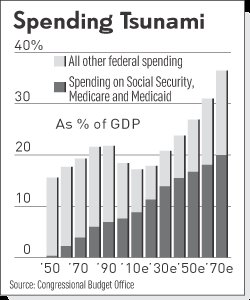
To his credit, the president tried to get Social Security reform rolling last year, but Democrats did their scare-the-oldsters routine and the GOP ran for the tall grass. This time, Washington may muster the courage to do something about the much smaller problem of pork and earmarks, but it will let another year go by while the entitlement train barrels along, getting harder to stop all the time.
Posted 3/7/2006
Government Spending: Is a line-item veto better than nothing? Probably. Is it enough to bring spending under control? Not by a long shot. The entitlement train is barreling along, and this won't slow it down.
With all due respect, it's hard to repress a chuckle when thinking about President Bush, Congress and their not-so-new idea for cutting government waste. Unveiled Tuesday by Bush, with statements of support from Republican leaders in the House and Senate, it's an updated version of that Washington perennial, the line-item veto.
No one, either friend or foe of Bush, can miss the irony in his request. He wants to be able to send specific items within bills back to Congress for reconsideration (calling it a "veto" may be too strong), but, of course, he already has the power to veto entire bills outright. And so far, he's not seen fit to do so. He's unusual in this respect. Only two presidents, James Monroe and Thomas Jefferson, went longer than Bush before vetoing a bill, and Bush will pass Monroe on March 20.
Congress has been every bit as guilty as the president. After all, it sends him the pork-stuffed legislation. So when its leaders second Bush's call for a rebirth of fiscal discipline, neither they nor the president can expect the public to take them seriously.
We're not saying the line-item veto would hurt. It might even help a little. It's just not what the country really needs, and Congress could eventually find ways to work around it.
In theory, forcing lawmakers to vote again on a special-interest item buried in a huge spending bill might embarrass them into reversing themselves.
But they could find new ways to bury the pork, as they did with the infamous "bridge to nowhere," a $320 million item inserted in last year's highway bill for a bridge from Ketchikan, Alaska, to its island airport. Under fire, Congress struck this line item, but ended up giving Alaska the money in general transportation funds.
There's also plenty to worry about beyond pork. In fact, the threat of runaway discretionary spending (over which Congress has year-to-year control) will soon pale in comparison to the growth on the mandatory side. This is the spending locked into law and expanding on autopilot, driven by demographics. Left unreformed, it ultimately will swallow up so much of the budget that precious little will be left for defense, not to mention bridges in the boondocks.
According to an estimate by the Congressional Budget Office, spending on the Big Three entitlements (Social Security, Medicare and Medicaid) will go from 41% of the federal budget in 2000 to 65% in 2040, with overall federal spending rising from 18.4% to 23.8% of GDP. Serious reform of these programs, including cuts in tax-paid benefits, would slow their growth to reasonable levels. But neither Bush nor Congress is talking about such action now.
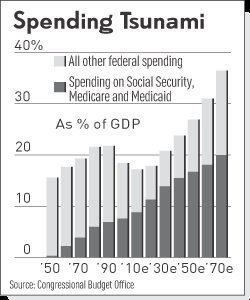
To his credit, the president tried to get Social Security reform rolling last year, but Democrats did their scare-the-oldsters routine and the GOP ran for the tall grass. This time, Washington may muster the courage to do something about the much smaller problem of pork and earmarks, but it will let another year go by while the entitlement train barrels along, getting harder to stop all the time.
Allah And Man At Yale
From IBD:
Posted 3/7/2006
Academia: If you doubt just how far to port our college campuses lean, consider that just as the nation's top law schools lose their fight to ban military recruiters, Yale admits a former member of the Taliban.
We don't know how many students have attended or are attending Yale under the G.I. Bill. But surely they are not amused by the admission to the alma mater of our last three presidents of Rahmatullah Hashemi. He is the former deputy foreign secretary of the Taliban, a group last seen still trying to kill American soldiers in Afghanistan.
Yale was one of the dozens of colleges and universities that went before the Supreme Court in December to argue that the Solomon Amendment, under which the feds are allowed to withhold federal funds from universities that bar federal recruiters from their campuses, was unconstitutional. This week the U.S. Supreme Court ruled that it was not.
We have reservations about the use of federal funds as a club to induce certain behavior. But we do believe that the U.S. military has as much a right to recruit its "employees" on university campuses as any other employer. We also think it's hypocritical for those who preach diversity and free speech to seek to bar from their campuses those with whom they disagree. Voltaire, call your office.
All eight sitting justices rejected the schools' contention that being forced to allow recruiters on campus violated their First Amendment rights. "Students and faculty are free to associate to voice their disapproval of the military's message," wrote Chief Justice John Roberts. "Recruiters are by definition, outsiders who come onto campus for the limited purpose of trying hire students — not to become members of the school's expressive association."
These champions of diversity and human rights say the real problem was the military's "don't ask, don't tell" policy on homosexuality. Admitting military recruiters violates their anti-discrimination policy, they claimed.
But it was Congress, not the Joint Chiefs of Staff, that passed "don't ask, don't tell," and at least one of the schools has no problem with the Taliban's position on homosexuality.
The hypocrisy is particularly egregious when academia honors the likes of Ward Churchill, the nutty professor who thinks the occupants of the World Trade Center were "little Eichmanns" who deserved their fate, and when one of our most prestigious schools admits a spokesman for one of the most oppressive governments in history.
We don't know if Mr. Hashemi has his eyes set on medical school, seeing that his regime once forbade women from seeing a male doctor or from becoming doctors themselves. So if you were a woman under the Taliban, many illnesses were death sentences.
Maybe he'll attend the prestigious Yale Law School, seeing that women under the Taliban couldn't attend school, much less teach in one. Or maybe the Yale archaeology department will welcome the representative of a thugocracy whose first official act was to blow up one of the great monuments of civilization, two giant centuries-old Buddhas carved into the side of a mountain.
Rahmatullah told The New York Times: "In some ways I'm the luckiest person in the world. I could have ended up at Guantanamo Bay. Instead I ended up at Yale."
He's certainly luckier then the dead American soldiers who were killed by the Taliban and therefore will never get to attend Yale. And as for Guantanamo, Mr. Hashemi, we'll leave a light on for you.
Posted 3/7/2006
Academia: If you doubt just how far to port our college campuses lean, consider that just as the nation's top law schools lose their fight to ban military recruiters, Yale admits a former member of the Taliban.
We don't know how many students have attended or are attending Yale under the G.I. Bill. But surely they are not amused by the admission to the alma mater of our last three presidents of Rahmatullah Hashemi. He is the former deputy foreign secretary of the Taliban, a group last seen still trying to kill American soldiers in Afghanistan.
Yale was one of the dozens of colleges and universities that went before the Supreme Court in December to argue that the Solomon Amendment, under which the feds are allowed to withhold federal funds from universities that bar federal recruiters from their campuses, was unconstitutional. This week the U.S. Supreme Court ruled that it was not.
We have reservations about the use of federal funds as a club to induce certain behavior. But we do believe that the U.S. military has as much a right to recruit its "employees" on university campuses as any other employer. We also think it's hypocritical for those who preach diversity and free speech to seek to bar from their campuses those with whom they disagree. Voltaire, call your office.
All eight sitting justices rejected the schools' contention that being forced to allow recruiters on campus violated their First Amendment rights. "Students and faculty are free to associate to voice their disapproval of the military's message," wrote Chief Justice John Roberts. "Recruiters are by definition, outsiders who come onto campus for the limited purpose of trying hire students — not to become members of the school's expressive association."
These champions of diversity and human rights say the real problem was the military's "don't ask, don't tell" policy on homosexuality. Admitting military recruiters violates their anti-discrimination policy, they claimed.
But it was Congress, not the Joint Chiefs of Staff, that passed "don't ask, don't tell," and at least one of the schools has no problem with the Taliban's position on homosexuality.
The hypocrisy is particularly egregious when academia honors the likes of Ward Churchill, the nutty professor who thinks the occupants of the World Trade Center were "little Eichmanns" who deserved their fate, and when one of our most prestigious schools admits a spokesman for one of the most oppressive governments in history.
We don't know if Mr. Hashemi has his eyes set on medical school, seeing that his regime once forbade women from seeing a male doctor or from becoming doctors themselves. So if you were a woman under the Taliban, many illnesses were death sentences.
Maybe he'll attend the prestigious Yale Law School, seeing that women under the Taliban couldn't attend school, much less teach in one. Or maybe the Yale archaeology department will welcome the representative of a thugocracy whose first official act was to blow up one of the great monuments of civilization, two giant centuries-old Buddhas carved into the side of a mountain.
Rahmatullah told The New York Times: "In some ways I'm the luckiest person in the world. I could have ended up at Guantanamo Bay. Instead I ended up at Yale."
He's certainly luckier then the dead American soldiers who were killed by the Taliban and therefore will never get to attend Yale. And as for Guantanamo, Mr. Hashemi, we'll leave a light on for you.
Party Naked
From IBD:
Posted 3/7/2006
Politics: Democrats can't take advantage of Republican missteps because they don't have an agenda of their own — or at least one that can win many votes this fall.
Why are congressional Democratic leaders continually delaying the unveiling of their legislative manifesto? Originally, the document's deadline was November. Then it was delayed to January. Since then it's been postponed twice. Now here it is March, and House Minority Leader Nancy Pelosi of California says it will have to wait at least a couple of more weeks.
When Pelosi and Senate Minority Leader Harry Reid of Nevada appeared before the Democratic Governors Association last month making separate presentations, the half-dozen issues they had ostensibly agreed to focus on were embarrassingly different from one another. Oregon Democratic Gov. Ted Kulongoski told The Washington Post: "I don't think we have a message."
A big reason for the delay in releasing a manifesto is that New York Sen. Chuck Schumer, chairman of the Democratic Senatorial Campaign Committee, and Illinois Rep. Rahm Emanuel, a former Bill Clinton aide who heads the Democratic Congressional Campaign Committee, have been urging Pelosi and Reid to hold off.
Schumer doesn't want it published until the summer.
It tells you something when the two people in charge of getting Democrats elected to Congress want candidates to avoid for as long as possible saying what they'll do after they take office. "We are going to do well if for no other reason than we are not them," Sen. Evan Bayh, D-Ind., told Bloomberg News this week.
But can going negative by itself secure victory? That's not the tack Republicans took in 1994, when they took over the Senate and gained 54 House seats, ending four straight decades of Democratic rule. Republicans that year successfully nationalized congressional elections with Newt Gingrich's Contract With America, a blueprint for what a GOP Congress would be like.
What happened in 1994 is clear. Hillary Clinton had just tried to socialize America's health care system — one-seventh of the national economy — via a secret task force. Gingrich coupled protection from the Clintons' plans to expand government economic power with a positive agenda that included a per-child tax credit, a capital gains tax cut, expanded IRAs, elimination of the tax code's marriage penalty and a balanced budget amendment.
But what would a Democrat "contract" amount to in 2006 beyond a giant "No!" followed by a fine-print agenda that includes higher taxes, gay marriage and an Iraq pullout?
With the Abramoff scandal, the Katrina calamity, the Scooter Libby indictment and unease about Iraq, Democrats might be seen as sure bets for winning big in November. But it doesn't say much for them that the only way they win is by hiding their true agenda from the American people.
Posted 3/7/2006
Politics: Democrats can't take advantage of Republican missteps because they don't have an agenda of their own — or at least one that can win many votes this fall.
Why are congressional Democratic leaders continually delaying the unveiling of their legislative manifesto? Originally, the document's deadline was November. Then it was delayed to January. Since then it's been postponed twice. Now here it is March, and House Minority Leader Nancy Pelosi of California says it will have to wait at least a couple of more weeks.
When Pelosi and Senate Minority Leader Harry Reid of Nevada appeared before the Democratic Governors Association last month making separate presentations, the half-dozen issues they had ostensibly agreed to focus on were embarrassingly different from one another. Oregon Democratic Gov. Ted Kulongoski told The Washington Post: "I don't think we have a message."
A big reason for the delay in releasing a manifesto is that New York Sen. Chuck Schumer, chairman of the Democratic Senatorial Campaign Committee, and Illinois Rep. Rahm Emanuel, a former Bill Clinton aide who heads the Democratic Congressional Campaign Committee, have been urging Pelosi and Reid to hold off.
Schumer doesn't want it published until the summer.
It tells you something when the two people in charge of getting Democrats elected to Congress want candidates to avoid for as long as possible saying what they'll do after they take office. "We are going to do well if for no other reason than we are not them," Sen. Evan Bayh, D-Ind., told Bloomberg News this week.
But can going negative by itself secure victory? That's not the tack Republicans took in 1994, when they took over the Senate and gained 54 House seats, ending four straight decades of Democratic rule. Republicans that year successfully nationalized congressional elections with Newt Gingrich's Contract With America, a blueprint for what a GOP Congress would be like.
What happened in 1994 is clear. Hillary Clinton had just tried to socialize America's health care system — one-seventh of the national economy — via a secret task force. Gingrich coupled protection from the Clintons' plans to expand government economic power with a positive agenda that included a per-child tax credit, a capital gains tax cut, expanded IRAs, elimination of the tax code's marriage penalty and a balanced budget amendment.
But what would a Democrat "contract" amount to in 2006 beyond a giant "No!" followed by a fine-print agenda that includes higher taxes, gay marriage and an Iraq pullout?
With the Abramoff scandal, the Katrina calamity, the Scooter Libby indictment and unease about Iraq, Democrats might be seen as sure bets for winning big in November. But it doesn't say much for them that the only way they win is by hiding their true agenda from the American people.
Tuesday, March 07, 2006
Saddam And WMD: Russia's Role
From IBD:
Posted 3/6/2006
Origins Of War: The feeding frenzy over the Katrina tapes stands in stark contrast to the obsessive disinterest of Democrats and the media in the Saddam tapes that show that Iraq had WMD and that Bush didn't lie.
The 12 hours of Saddam tapes made public confirm, in the words of Saddam Hussein himself and his top aides, that Iraq had WMD, was working on WMD and was conspiring to deceive U.N. inspectors about their existence and to hide and disperse them. But Bush critics seemingly are not as interested as they are in videotapes that might indict the president on Katrina.
If the WMD existed, what happened to them? Where did they go? As we have noted, just before Operation Iraqi Freedom both Israeli intelligence and U.S. satellite surveillance detected large amounts of military material moving from Iraq to Syria.
But this was not a panicked move. Rather, it was a well-planned operation conducted with the assistance of Russia, to which Iraq was $8 billion in debt, much of it for weapons. Russia was worried about what coalition forces might find.
According to John Shaw, former deputy undersecretary for international technology security, the WMD were moved out of Iraq by Russian special forces, or Spetsnaz, units. "While in Iraq," Shaw states, "I uncovered detailed information that Spetsnaz units shredded records and moved all WMD and specified advanced munitions out of Iraq to Syria and Lebanon."
Former top Romanian spy chief Ion Mihai Pacepa has written about the existence of "a standard Soviet operating procedure for deep-sixing weapons of mass destruction" in Soviet client states. The plan, which the Romanians called "Sarindar," or "emergency exit," was initially designed for Libya — a Reagan administration target — and implemented in Iraq.
According to an article by David Dastych in the Canada Free Press, the operation in Iraq was carried out by Russia's GRU (Military Intelligence), Spetsnaz (Special Troops) and Russian military and civilian logistic personnel in Iraq under the command of two veteran ex-Soviet generals — Vladislav Achalov and Igor Maltsev, operating under the guise of being civilian consultants.
Photos taken in early 2003 show Achalov and Maltsev receiving awards from Iraqi Defense Minister Sultan Hashim Akhmed in a building destroyed by U.S. cruise missiles.
What were they receiving awards for just days before coalition forces began their rush to Baghdad? Achalov reportedly said he "didn't fly to Baghdad to drink coffee."
Remember the 380 tons of high explosives that were reported missing from the Al-Qaqaa military installation south of Baghdad in the fall of 2004, explosives so powerful they could be used to detonate nuclear weapons? It was charged then that the Bush administration failed to guard the facility, allowing it to be looted and much of its dangerous contents to fall into the hands of insurgents.
U.S. forces liberated the facility around April 2, 2003, finding the gates to the facility wide open. Inspections by the Army's 75th Exploitation Task Force on May 8, May 11 and May 27, 2003, found no high explosives that had been monitored by the IAEA in the past.
So what happened to them? The Pentagon issued a statement saying the "movement of 377 tons of heavy ordnance would have required dozens of heavy trucks," not something ragtag elements of a crumbling resistance could have managed on roads occupied by an onrushing U.S. Army.
Who could have mounted such an effort? Maybe the WMD were on some of those trucks driven out of Iraq into Syria, likely under Russian supervision. The answer may be on the reported 3,000 hours of tape recovered by U.S. forces, only 12 hours of which have been heard.
As results of an IBD/TIPP Poll taken last week show (see chart), few Americans are even aware of the existence of Saddam tapes that prove that prewar intelligence was not wrong and that Bush was right.
We'd like to hear more and have the American people know more, but so far many in Congress and particularly in the media are still waitin' on the levee.

Posted 3/6/2006
Origins Of War: The feeding frenzy over the Katrina tapes stands in stark contrast to the obsessive disinterest of Democrats and the media in the Saddam tapes that show that Iraq had WMD and that Bush didn't lie.
The 12 hours of Saddam tapes made public confirm, in the words of Saddam Hussein himself and his top aides, that Iraq had WMD, was working on WMD and was conspiring to deceive U.N. inspectors about their existence and to hide and disperse them. But Bush critics seemingly are not as interested as they are in videotapes that might indict the president on Katrina.
If the WMD existed, what happened to them? Where did they go? As we have noted, just before Operation Iraqi Freedom both Israeli intelligence and U.S. satellite surveillance detected large amounts of military material moving from Iraq to Syria.
But this was not a panicked move. Rather, it was a well-planned operation conducted with the assistance of Russia, to which Iraq was $8 billion in debt, much of it for weapons. Russia was worried about what coalition forces might find.
According to John Shaw, former deputy undersecretary for international technology security, the WMD were moved out of Iraq by Russian special forces, or Spetsnaz, units. "While in Iraq," Shaw states, "I uncovered detailed information that Spetsnaz units shredded records and moved all WMD and specified advanced munitions out of Iraq to Syria and Lebanon."
Former top Romanian spy chief Ion Mihai Pacepa has written about the existence of "a standard Soviet operating procedure for deep-sixing weapons of mass destruction" in Soviet client states. The plan, which the Romanians called "Sarindar," or "emergency exit," was initially designed for Libya — a Reagan administration target — and implemented in Iraq.
According to an article by David Dastych in the Canada Free Press, the operation in Iraq was carried out by Russia's GRU (Military Intelligence), Spetsnaz (Special Troops) and Russian military and civilian logistic personnel in Iraq under the command of two veteran ex-Soviet generals — Vladislav Achalov and Igor Maltsev, operating under the guise of being civilian consultants.
Photos taken in early 2003 show Achalov and Maltsev receiving awards from Iraqi Defense Minister Sultan Hashim Akhmed in a building destroyed by U.S. cruise missiles.
What were they receiving awards for just days before coalition forces began their rush to Baghdad? Achalov reportedly said he "didn't fly to Baghdad to drink coffee."
Remember the 380 tons of high explosives that were reported missing from the Al-Qaqaa military installation south of Baghdad in the fall of 2004, explosives so powerful they could be used to detonate nuclear weapons? It was charged then that the Bush administration failed to guard the facility, allowing it to be looted and much of its dangerous contents to fall into the hands of insurgents.
U.S. forces liberated the facility around April 2, 2003, finding the gates to the facility wide open. Inspections by the Army's 75th Exploitation Task Force on May 8, May 11 and May 27, 2003, found no high explosives that had been monitored by the IAEA in the past.
So what happened to them? The Pentagon issued a statement saying the "movement of 377 tons of heavy ordnance would have required dozens of heavy trucks," not something ragtag elements of a crumbling resistance could have managed on roads occupied by an onrushing U.S. Army.
Who could have mounted such an effort? Maybe the WMD were on some of those trucks driven out of Iraq into Syria, likely under Russian supervision. The answer may be on the reported 3,000 hours of tape recovered by U.S. forces, only 12 hours of which have been heard.
As results of an IBD/TIPP Poll taken last week show (see chart), few Americans are even aware of the existence of Saddam tapes that prove that prewar intelligence was not wrong and that Bush was right.
We'd like to hear more and have the American people know more, but so far many in Congress and particularly in the media are still waitin' on the levee.
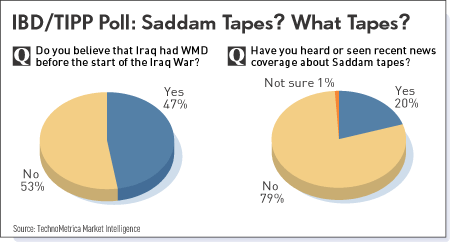
Unfinished Business
From IBD:
Posted 3/6/2006
Tax Cuts: House Ways and Means Chairman Bill Thomas, R-Calif., has announced he'll retire from Congress when his term ends. But he's got a big job to do first: making the Bush tax cuts permanent.
'I haven't finished my work, and I have nine months to go," Thomas said as he announced Monday that, with self-imposed term limits ending his chairmanship of the House Ways and Means Committee, he wouldn't run for re-election.
As chief House tax writer, Thomas deserves plaudits for improving President Bush's tax-cut program, specifically reducing the capital gains rate to 15%. Bush wanted to eliminate taxes on dividend income; Thomas floated a compromise to tax both capital gains and dividends at the lower 15%. Convincing the White House, fellow congressmen, and the Senate was no mean feat.
The lower cap-gains rate has been a big boost to what is now a powerful economic expansion, and a great deal of the thanks goes to Thomas. He also defied the odds by making progress in international tax reform, and was a key player in passing CAFTA.
But there's been a downside, too — like Thomas' role in securing Republican votes for the huge expansion of Medicare via a new prescription drug benefit.
For that, the Foundation for Taxpayers and Consumer Rights called Thomas "an embarrassment." And the conservative California Republican Assembly this past weekend officially welcomed Thomas' "none-too-soon retirement" as a big spender.
But Thomas has some big fans. One is Stephen Entin, president of the Institute for Research on the Economics of Taxation, who lauds Thomas' accomplishments and his ability to work with Congress, especially in cutting the capital gains tax. "At times when people had given up on getting good ideas enacted, he got backing in Congress and got it done," Entin told IBD.
Thomas says in the time he has left he wants to reform our "flawed income tax structure."
A full-blown tax reform that shields savings and eliminates double taxation, while very welcome, is an ambitious goal this election year. But with Thomas' formidable abilities, Entin thinks he could instead use his remaining months as chairman to repeal the burdensome estate tax, and make the lower tax rate on capital gains and dividends permanent.
In doing so, Thomas would help keep our current economic boom going. He'd also cement his own legacy as one of the most effective Ways and Means chairmen in history.
Posted 3/6/2006
Tax Cuts: House Ways and Means Chairman Bill Thomas, R-Calif., has announced he'll retire from Congress when his term ends. But he's got a big job to do first: making the Bush tax cuts permanent.
'I haven't finished my work, and I have nine months to go," Thomas said as he announced Monday that, with self-imposed term limits ending his chairmanship of the House Ways and Means Committee, he wouldn't run for re-election.
As chief House tax writer, Thomas deserves plaudits for improving President Bush's tax-cut program, specifically reducing the capital gains rate to 15%. Bush wanted to eliminate taxes on dividend income; Thomas floated a compromise to tax both capital gains and dividends at the lower 15%. Convincing the White House, fellow congressmen, and the Senate was no mean feat.
The lower cap-gains rate has been a big boost to what is now a powerful economic expansion, and a great deal of the thanks goes to Thomas. He also defied the odds by making progress in international tax reform, and was a key player in passing CAFTA.
But there's been a downside, too — like Thomas' role in securing Republican votes for the huge expansion of Medicare via a new prescription drug benefit.
For that, the Foundation for Taxpayers and Consumer Rights called Thomas "an embarrassment." And the conservative California Republican Assembly this past weekend officially welcomed Thomas' "none-too-soon retirement" as a big spender.
But Thomas has some big fans. One is Stephen Entin, president of the Institute for Research on the Economics of Taxation, who lauds Thomas' accomplishments and his ability to work with Congress, especially in cutting the capital gains tax. "At times when people had given up on getting good ideas enacted, he got backing in Congress and got it done," Entin told IBD.
Thomas says in the time he has left he wants to reform our "flawed income tax structure."
A full-blown tax reform that shields savings and eliminates double taxation, while very welcome, is an ambitious goal this election year. But with Thomas' formidable abilities, Entin thinks he could instead use his remaining months as chairman to repeal the burdensome estate tax, and make the lower tax rate on capital gains and dividends permanent.
In doing so, Thomas would help keep our current economic boom going. He'd also cement his own legacy as one of the most effective Ways and Means chairmen in history.
Tehran's Game
From IBD:
Posted 3/6/2006
Nuclear Arms: Iran passes a crucial deadline this week for its nuclear program. Not that it seems to care. In fact, it thinks it's pulled the wool over the West's eyes.
As the West awaits word on whether Iran will halt its insane march to nuclear power status, we learn that Tehran is having a big laugh at our expense. Iran's leaders, clearly relishing the spotlight and the West's eagerness to accommodate them, have decided they can flout international law and build a nuclear weapon without interference.
According to an account in The Telegraph, a U.K. newspaper, Iran's former top nuclear negotiator, Hassan Rowhani, bragged at a recent closed meeting of Iran's Supreme Council of Cultural Revolution that Tehran has duped the West into believing Iran has no nuclear program. Especially gullible, he said, were the so-called EU3: Britain, France and Germany
"From the outset, the Americans kept telling the Europeans, 'The Iranians are lying and deceiving you, and they have not told you everything,' " Rowhani is quoted as saying. "The Europeans used to respond, 'We trust them.' "
In fact, as Rowhani noted, Iran went forward with its plan to re-equip its Isfahan nuclear plant to enrich uranium for ultimate use in a nuclear device even after Iran's covert nuclear program was first revealed in 2002. The Iranians have lied repeatedly and broken the law.
They ran into trouble, however, after Libya secretly negotiated a deal with the U.S. and Britain to give up its illicit nuclear program. As Rowhani acknowledges, Iran got some of its high-tech centrifuges from the same source — Pakistan's rogue atomic dealer A.Q. Khan.
Knowing this, does anyone doubt Iran's ultimate intentions?
Iran claims it wants nuclear technology solely for "peaceful" purposes. Yet it rejects every offer to provide the country with technology for peaceful purposes, with checks and balances that would satisfy the global community's legitimate concerns.
That's why we were surprised Monday to hear Mohamed ElBaradei, head of the International Atomic Energy Agency, say he was "very much hopeful" that a deal with Iran could be struck. ElBaradei believes talks between Moscow and Tehran about basing Iran's nuclear enrichment activities on Russian soil will answer all questions about Iran's intent.
But after reading Rowhani's comments, it appears that's not the case. Iran's program has been designed to yield a nuclear bomb. And once it has one, it might use it against Israel, Europe or both. It will also be in a position to slip crude nukes into the hands of the growing number of terrorist groups that hang their hats in Tehran.
The U.S., alone, has remained unswayed by Iran's lies and propaganda. For that, we can thank John Bolton, who has justified the faith that President Bush showed last year by making him our ambassador to the United Nations.
On Monday, the IAEA prepared to hand the issue over to the U.N. Security Council, which has the power to impose economic or other sanctions. One option the Security Council does not have, however, is doing nothing. As Bolton put it over the weekend: "The longer we wait, the harder it will be to solve."
Bolton also vowed that regardless what the U.N. does, the U.S. will use "all the tools" it has to stop Iran from getting nuclear weapons. "All the tools." When Iranian leaders stop gloating, they might ponder all that might entail.
Posted 3/6/2006
Nuclear Arms: Iran passes a crucial deadline this week for its nuclear program. Not that it seems to care. In fact, it thinks it's pulled the wool over the West's eyes.
As the West awaits word on whether Iran will halt its insane march to nuclear power status, we learn that Tehran is having a big laugh at our expense. Iran's leaders, clearly relishing the spotlight and the West's eagerness to accommodate them, have decided they can flout international law and build a nuclear weapon without interference.
According to an account in The Telegraph, a U.K. newspaper, Iran's former top nuclear negotiator, Hassan Rowhani, bragged at a recent closed meeting of Iran's Supreme Council of Cultural Revolution that Tehran has duped the West into believing Iran has no nuclear program. Especially gullible, he said, were the so-called EU3: Britain, France and Germany
"From the outset, the Americans kept telling the Europeans, 'The Iranians are lying and deceiving you, and they have not told you everything,' " Rowhani is quoted as saying. "The Europeans used to respond, 'We trust them.' "
In fact, as Rowhani noted, Iran went forward with its plan to re-equip its Isfahan nuclear plant to enrich uranium for ultimate use in a nuclear device even after Iran's covert nuclear program was first revealed in 2002. The Iranians have lied repeatedly and broken the law.
They ran into trouble, however, after Libya secretly negotiated a deal with the U.S. and Britain to give up its illicit nuclear program. As Rowhani acknowledges, Iran got some of its high-tech centrifuges from the same source — Pakistan's rogue atomic dealer A.Q. Khan.
Knowing this, does anyone doubt Iran's ultimate intentions?
Iran claims it wants nuclear technology solely for "peaceful" purposes. Yet it rejects every offer to provide the country with technology for peaceful purposes, with checks and balances that would satisfy the global community's legitimate concerns.
That's why we were surprised Monday to hear Mohamed ElBaradei, head of the International Atomic Energy Agency, say he was "very much hopeful" that a deal with Iran could be struck. ElBaradei believes talks between Moscow and Tehran about basing Iran's nuclear enrichment activities on Russian soil will answer all questions about Iran's intent.
But after reading Rowhani's comments, it appears that's not the case. Iran's program has been designed to yield a nuclear bomb. And once it has one, it might use it against Israel, Europe or both. It will also be in a position to slip crude nukes into the hands of the growing number of terrorist groups that hang their hats in Tehran.
The U.S., alone, has remained unswayed by Iran's lies and propaganda. For that, we can thank John Bolton, who has justified the faith that President Bush showed last year by making him our ambassador to the United Nations.
On Monday, the IAEA prepared to hand the issue over to the U.N. Security Council, which has the power to impose economic or other sanctions. One option the Security Council does not have, however, is doing nothing. As Bolton put it over the weekend: "The longer we wait, the harder it will be to solve."
Bolton also vowed that regardless what the U.N. does, the U.S. will use "all the tools" it has to stop Iran from getting nuclear weapons. "All the tools." When Iranian leaders stop gloating, they might ponder all that might entail.
Subscribe to:
Posts (Atom)